
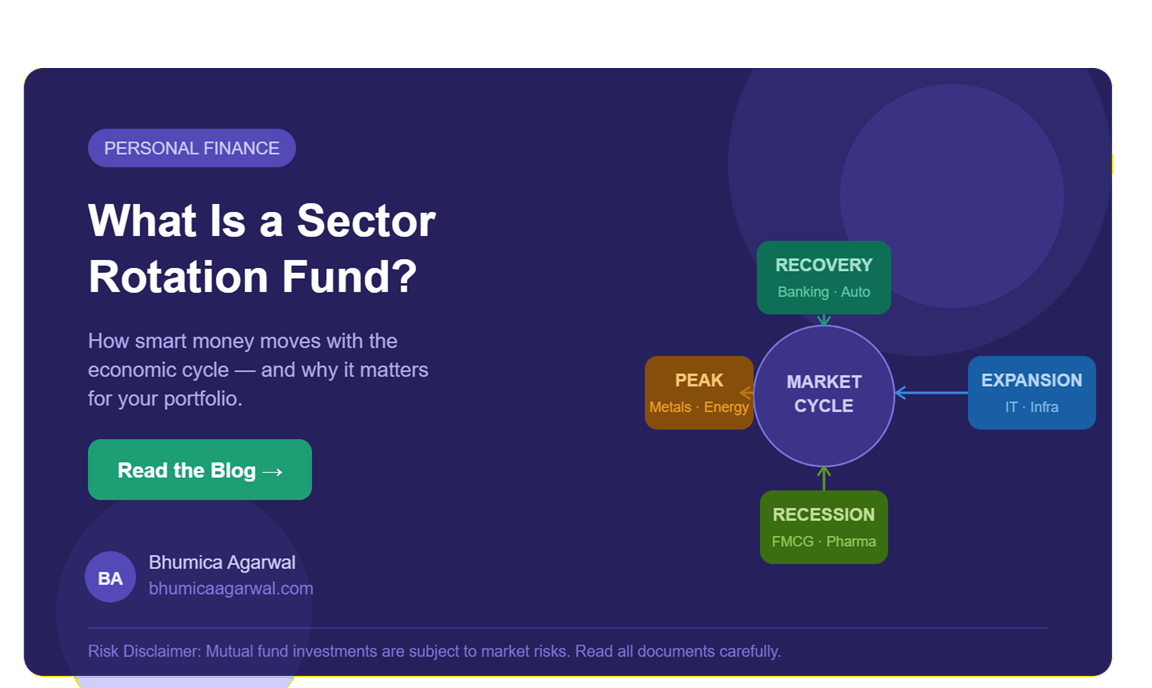
A sector rotation fund is an open-ended mutual fund that intentionally reallocates its portfolio across multiple sectors. This sector reallocation aims at achieving relative outperformance based on economic cycle indicators. The sectors that can form part of a sector rotation fund include defense, metals, IT, banking, auto, pharma, etc.
Sector rotation funds, classified as sectoral/thematic funds, are relatively new in the Indian markets. According to SEBI’s categorization norms, sectoral funds must allocate at least 80% of their portfolios to stocks in the chosen sector.
In this blog, we will explore how sector rotation funds operate, the potential benefits and key risks of these funds, and how you can invest in a sector rotation fund.
How do Sector Rotation Funds Operate?
Sector rotation funds operate by reading economic cycles, which often govern a sector’s performance, and rebalancing their portfolio accordingly. There are 4 broad market cycles, namely, expansion, peak, contraction, and recovery.
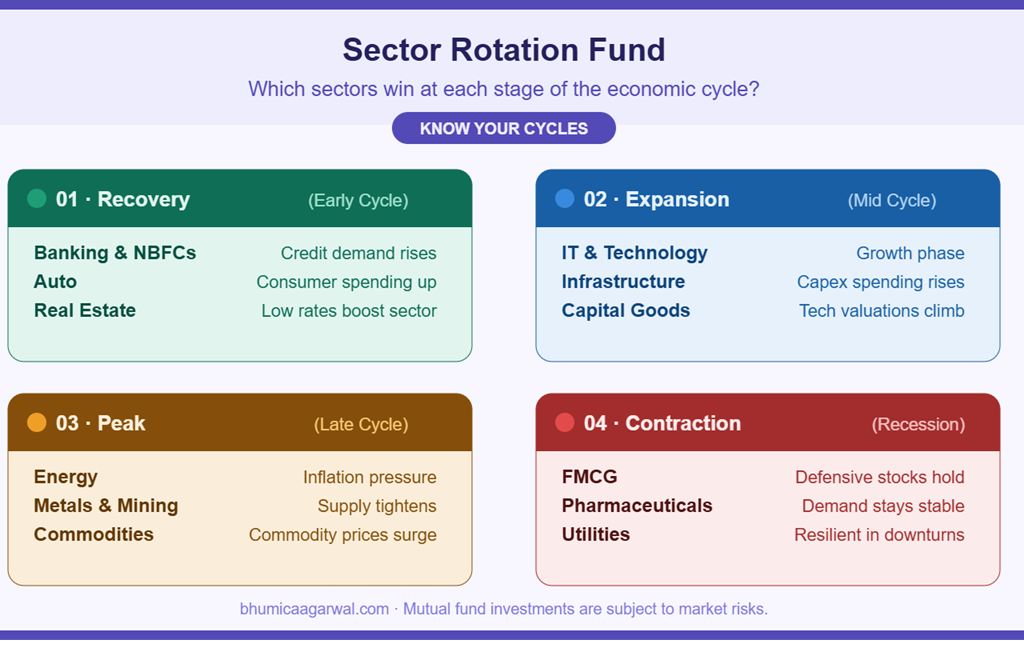
Based on the above information, fund managers:
- Use technical indicators (valuations, momentum, market sentiment, etc.) and macroeconomic data (GDP growth, interest rates, inflation, etc.) to identify undervalued sectors with potential signs of reversals.
- Then they rebalance their portfolio into the sectors that may outperform.
- When a sector shows signs of a downtrend or the economic cycle changes, the fund manager may repeat the cycle of reassessment and rebalance toward sectors showing improving trends.
For example, certain commodity-linked sectors have performed strongly during periods of global supply shifts, while some technology segments experienced valuation turbulence. Fund managers may have used a sector rotation strategy to increase allocation in metals while reducing their stake in the IT sector.
Potential Benefits of a Sector Rotation Fund
Investing in a sector rotation fund may provide the following benefits:
- Active risk management with diversification within an uptrend sector.
- Potential for better returns by investing in sectors outperforming broader markets based on professional expertise.
- Time savings by not having to research and select high-performing individual stocks.
- Potential tax efficiency compared to frequent individual stock transactions, as taxation occurs only when units are redeemed.
These funds may offer a strategic investment advantage, including professional portfolio management, lower costs than investing in individual stocks, and reduced stagnation of returns.
Key Risks of a Sector Rotation Fund
Despite their multiple benefits, investing in sector rotation funds carries a higher concentration risk during sector downturns. Additionally, they are a relatively new addition to the Indian markets with no historical data to track performance. Therefore, investors may consider reviewing scheme documents and understanding the underlying strategy before investing.
How Can I Invest in a Sector Rotation Fund?
You can invest in a sector rotation fund offline or online. For offline investing, you can visit your preferred asset management company’s or mutual fund distributor’s office.
You can also invest online through a brokerage platform, fintech apps, or an asset management company’s website. Online investing in a sector rotation fund offers convenience, as you can log in to your Demat account and invest in your chosen sector rotation fund with a single click.
Sector Rotation Funds: Suitability for Indian Investors
Markets are dynamic in nature. Economic cycles and sector rotations could significantly affect your portfolio returns. Sector rotation investing aims to select sectors that are underperforming or overvalued. However, predicting market cycles could be challenging, and there could be prolonged periods of underperformance.
Sector rotation funds are typically positioned as actively managed strategies that adjust sector allocations. Notably, outcomes depend on market conditions and fund execution. As with any equity investment, investors should evaluate their risk tolerance, investment horizon, and financial goals before making decisions.
FAQs on Sector Rotation Fund
- How are sectoral funds different from sector rotation funds?
Sectoral funds allocate at least 80% of their portfolios to a particular sector, such as IT, banking, pharma, etc. In contrast, a sector rotation fund dynamically reallocates its portfolio across sectors based on economic cycles and market trends.
- Is a sector rotation fund suitable for a conservative investor?
Since most sector rotation funds are considered very high risk, they may not be suitable for conservative investors or those with a short-term investment horizon.
- Which sector rotation fund is best?
Since sector rotation funds are emerging in India, there isn’t enough historical data to classify them based on past performance. Some funds available in India are:
-JioBlackRock Fund: an open-ended, equity-oriented fund aiming for long-term wealth appreciation, and
-Shriram Multi Sector Rotation Fund: a quantamental approach of investing in equity and equity derivatives of uptrending sectors
- Can I do a SIP in sector rotation funds?
Yes, you can invest in most sector rotation funds through a systematic investment plan (SIP) mode. Please connect with your broker for more details.
Also read Investing 101: Mutual Funds vs. FDs vs. Stocks
Disclaimer:
This website is created and authored by Bhumica Agarwal and is published and provided for informational and entertainment purposes only. The information in the Blog constitutes the Content Creator’s own opinions (and any guest bloggers posting from time to time), and it should not be regarded as a description of services or recommendations.
The opinions expressed in the Blog are for general informational purposes only and are not intended to provide specific advice or recommendations for any individual or on any specific security or investment product. It is only intended to provide education about the financial industry. The views reflected in the commentary are subject to change at any time without notice.
Nothing on this Blog constitutes investment advice, performance data, or any recommendation that any security, portfolio of securities, investment product, transaction, or investment strategy is suitable for any specific person. From reading this Blog, we cannot assess anything about your personal circumstances, your finances, or your goals and objectives, all of which are unique to you, so any opinions or information contained in this Blog are just that – an opinion or information. You should not use this Blog to make financial decisions, and we highly recommend you seek professional advice from someone who is authorized to provide investment advice.
Any indices referenced for comparison are unmanaged and cannot be invested directly. Investments in securities involve the risk of loss. Past performance is no guarantee of future results. We like to share links to articles and information that interest us. It is in no way an endorsement by us or by anyone associated with us.